
There comes a time in every moped courier’s career when riding really starts to feel like the job it is, and can remain little more than that for decades at a time. Those little moments of excitement from the early days fade, chipped away by the cold hard slog that is courier work. Eventually, you can start to forget why riding is supposed to be fun in the first place.
But sometimes, while waiting at traffic lights (for the hundredth time that shift), I’d get filtered past and subsequently left in the dust by a motorcyclist, all cylinders firing loud and proud. That’s all it took to plant the seed in me, and by the time I’d saved up enough money to buy my own bike, I steered away from just getting my own moped. My Suzuki RV125 VanVan has held a special place in my heart ever since.
Before I knew it I was old enough to take a Direct Access course, and my job application to MCN was actually accepted too. That’s when I could sense the universe was sending me a message. “It’s finally time” I thought.
The riding school
My previous experiences doing multiple CBT’s locally has been a mixed bag, so I wanted to go with an established riding school with a good reputation to do my full license. Thankfully, all of Honda’s training centres fit the bill here, and the closest one to me was The Ride Academy at Smith’s Honda, in Chester.
This a five-star Honda school, and for me it really shows. The moment I walked through their door I was instantly welcomed like one of their own, and every step of the way thereafter I couldn’t have had a better journey. Every one of their instructors are veteran riders in their own right, each having more riding experience under their belt than I will probably ever have.
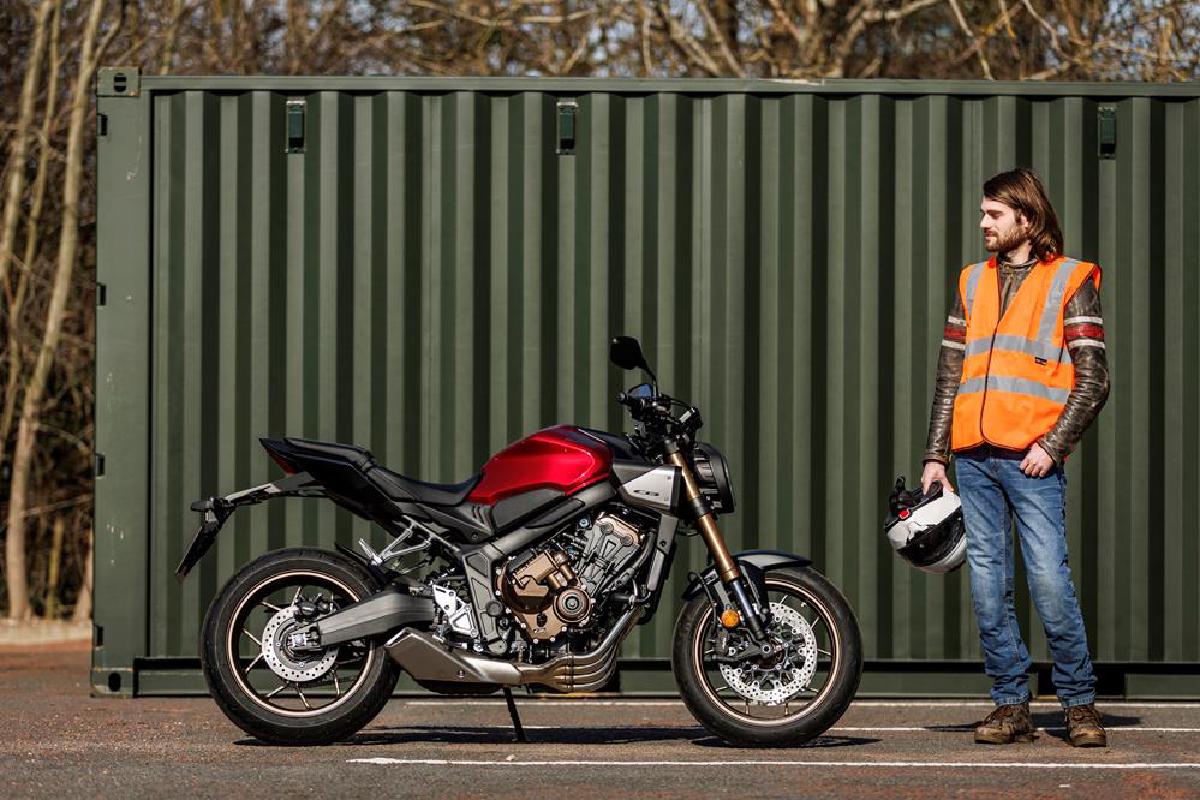
They have an impressive fleet of bikes that get changed out regularly; during my training they switched from new CB650R’s to the new CB750 Hornet (which I much preferred). They offer bikes with Honda’s DCT for getting an automatic licence too, which is great if a clutch and gears just aren’t for you — what’s not to love about a 750cc moped?
You can do your training in a one week intensive course if you like, but I decided to book one or two lessons per week, which spread my training out to just over a month. I find the teaching sticks better if I have the time to let it sink in, and I didn’t have to book a whole week off work to do it. They’re quite flexible with lesson bookings, so whatever your schedule looks like they can always find a way to make it work.
Bridge lesson
One bonus for starting as a moped courier is you don’t need to do another CBT, but the Ride Academy like to give a ‘bridge’ lesson just to see what level of riding you’re at regardless. It helps them help you, so if you don’t do a CBT with them, I’d say take it.
It was pretty painless compared to my last CBT too; a quick theory rundown before heading out onto the streets on a new CB125F to check out my road craft. This was when I started to notice just how knowledgeable the instructors are — every one of them is a thoroughly seasoned rider. Some have the scars to prove it, but all have a way to explain riding technique that just makes sense, even before you put it into practice. I already knew most of the riding theory Dave was going over in my bridge lesson, but he reinforced my knowledge by making connections from different road situations I hadn’t considered.
Since I’d been riding my 125cc bike almost every day for a couple of years, there weren’t any dramas out on the road. I was wobbling a bit on the skinny tyres of the CB125F, and riding more reactively than proactively, but Dave assured me that both of these traits would be quickly ironed out in training. After that, I was ready to start working towards the mod 1 test.
Well, almost ready. There was one obstacle in my way…
Theory test
The motorcycle theory test is a notorious pain in the backside, especially if you already did it to get your driving license, as they’re practically identical aside from a handful of bike-specific questions. But, I tried to keep the goal in mind as I calmly sat down behind the monitor. Parking up in Bala, I had a look around and suspiciously opened the door on the back of the HGV trailer, labelled “DVSA Mobile Testing Vehicle”.
I didn’t expect to be doing my theory test in the back of a lorry, but I wasn’t going to question it too much. I’d already had to wait a few weeks just to get my chance to do it, and by now it was the day before my Mod 1. This didn’t help with the pressure, but using the past couple of weeks to revise with some mock quizzes on YouTube meant I was fully prepared for the multiple choice segment.
The hazard perception always seems rigged at first, but it becomes a breeze when you learn about the three click trick: one click when you see a potential hazard, another if the hazard develops, then a safety click a moment after. Spotting the hazards themselves becomes second nature if you’ve been riding or driving for a while already, it’s just knowing when to click that can catch you out. I opened my results slip on my way out with a satisfied grin, and gave Luke at the Ride Academy a call to deliver the good news.
Mod 1
You won’t often catch me waking up at 5am on a Monday morning, but I made an exception to do my Mod 1 test, and despite the tiredness I was looking forward to it. My Mod 1 was booked in Shrewsbury, so we had a good hour’s ride out on some nice flowing A-roads on our way down. It was the first time me and the CB650R got to stretch our legs a bit, and was a nice way to distract from the impending stress of the Mod 1 — especially in the brief moments when my instructor Steve was out of sight…
Mod 1 is the part that new riders tend to struggle most with, but I had one ace up my sleeve — I’m not a new rider. Dodging and weaving through the cones, maintaining a walking-pace crawl with the bike, and making U-turns all came as naturally to me on the test ground as they did out on the streets of London, and I passed first time. Though, with one minor fault — there really is something about the feeling of being examined that makes it way harder, no matter how confident you are going in.
The only hiccup for me came from going a bit too slow into the hazard avoidance manoeuvre, and the examiner had to ask me to do it again. But, this is where riding a manual 125cc bike every day probably saved me a resit fee — practice makes perfect.
When I was first recruited as a courier, we had to demonstrate our slow riding abilities in a similar way to the Mod 1 test as part of our application process. My first time round the track, my U-turn was so wide I almost hit the wall and had to bail out! But, because they really needed couriers, they held me back after everyone else had left to give me another chance. I barely scraped through, and definitely didn’t feel ready to be riding in south-east London for 12+ hours at a time, no matter how enthusiastic and hopeful my interviewer was. So, since I felt my life depended on it, I made a pact with myself to use my shifts as a chance to improve my riding.
So, I made a game out of it. While out on shift, I’d try my best not to put a foot down in slow moving traffic, and try to make each U-turn out of the depot tighter than the last. I gained a lot of confidence in quite little time just by doing these, it even surprised me. These stuck with me when I was doing my rider training; I often did slow-races against myself whenever I was coming back home from a ride, and would sometimes just ride in circles in car parks, progressively making them tighter and slower. Riding gets more difficult the slower you’re going, but once you master that, the fast stuff becomes a lot easier.
Mod 2
Getting ready for the Mod 2 test was probably the trickiest bit for me, because some old habits really do die hard. I had confidence handling the bike at slow speeds in the car park, but that was only half the story. My instructor Lee noticed I was still a bit erratic with my approach overtaking parked cars and too quick into junctions, a habit formed back when time was money out on the bike. It was difficult to shake off, but the promise of being a safer rider was well worth rewiring my brain for, and each of my instructors made that process a lot easier than it had any right to be.
Everyone at the Ride Academy emphasises that good riding habits are far more important than knowing how to pass a test, and I really appreciated how their style of instruction was tailored to your own safety out on the road, not what the examiners want to see. Through mostly teaching myself how to ride I’d picked up some bad habits, but I never would’ve noticed them if I hadn’t gone through full training. Once said habits had been successfully rewired, I felt a lot more in control of the machine, less stressed out, and I experienced far fewer near-miss situations at junctions. Now I just had to take the test and prove it.
Tensions were high as I rode down to the test centre in Chester, but for no reason beyond nerves. Dave had faith in me, and in his teachings. “When you walk in wearing that bib, he’s expecting to pass you” he says, trying to keep me calm. He explains that anxiety is the big killer on most tests, and that’s the main thing we’d been training for in our mod 2 lessons. I knew I had all the skills, I just needed the determination to get through it. So, when instructed to do so by my examiner, I hopped on the bike and turned the key. The mantra Dave had inscribed into me was playing on repeat in my mind almost the whole time.
Just two mates out for a ride… Just two mates out for a ride… …
And, the next thing I know, I’m back at the test centre. I look up to find my examiner delivering the news, and get taken off-guard when he does. “Oh, thank god!”, my voice acts on its own as I suddenly feel able to breathe again. Dave gives me a beaming smile, and congratulates me in kind. Now, I’m the proud owner of an unrestricted motorcycle licence.
As it turns out, I only got one minor fault, and my examiner asks me if I know what it was. The fact he asks me at all catches me off guard, and I scramble back through my mind to no avail, so he leans in with a small grin. “Here in the test centre, when you were about to set off, you selected first gear before kicking up the kickstand, and the engine cut off. Other than that, your test was flawless!”
As much as I’ll never be able to live that down, it serves as a good reminder that the best way to ride is to keep calm and carry on. Although that’s easier said than done on test day, at least it’s a lesson I won’t forget now!
Freedom!
Riding the moped on a Friday night in south-east London often felt claustrophobic and stressful. The smog filling my lungs even made breathing a chore, the roads were heavily congested, and I was always on the clock whether I liked it or not.
But riding back from the test centre in Chester on a CB750 Hornet, with calm open roads and the summer breeze, it just felt amazing. I was overwhelmed with that sense of freedom, realising how far I’d come, and basked in it right up until the moment I turned the key and hopped off the bike.
“Watching how you ride now, I couldn’t tell you’d just passed your test” Dave said, as I parked up outside the Ride Academy for the final time. “Just keep riding like that”.
It’s safe to say my previous life as a moped courier definitely put me at an advantage during my rider training. There’s no substitute for road experience, and couriers get more of that than any other rider on L-plates. Even learning the clutch and gears was relatively easy for me, since I already had good balance and throttle control, and I was able to do it in my own time on my own bike. You won’t be missing out if you just go for an automatic license though, there’s plenty of properly exciting bikes with automatic transmissions on the market nowadays.
The trickiest bit was unlearning my bad habits, but even an old dog can learn new tricks if trained well, and doing rider training has made me a safer rider. For anyone working every day on the bike, that alone is worth it’s weight in gold. L-plates won’t protect you like good road-craft will, and I felt a massive step up in my confidence behind the bars by the time I’d passed. Practising by myself upgraded my riding technique a lot, but I never would’ve been Mod 2 ready without their tuition.
The Ride Academy offered me a small discount on any brand new bike from Smith’s for having done my training with them, which I think is a nice gesture, but I still have to take them up on that. Sadly, life circumstances have held my finances at gunpoint these last few months, and I’ve not been able to buy another bike yet. But, I’m always on the lookout — feel free to fire any suggestions my way!
Even without owning a bigger bike yet, I’m still reaping the benefits of having done my rider training. Cheaper insurance on my 125cc, vastly improved confidence, and being able to ride abroad are the ones I make the best use of (or plan to). It opens up more options for courier work too; blood bikers, for example, all require advanced training.
Not everyone is lucky enough to get sponsored by Honda to do their full license, but all things considered I think The Ride Academy price their lessons well. Dave, Lee, Ian and Steve all are all excellent instructors, and great people in their own right, plus you get to ride some brand new machinery that in my experience was always well maintained.
If I want to do any advanced rider training in the future I’ll be sure to give them a call, or even if I’m just in the area, I know there’ll be a cuppa and a chinwag waiting for me there.